The framework
What is the Promise Gap?
The distance between what an organisation promises its people and what those people actually experience.
Developed by Shehzad Bhanji · First published July 2026 · Canonical definition
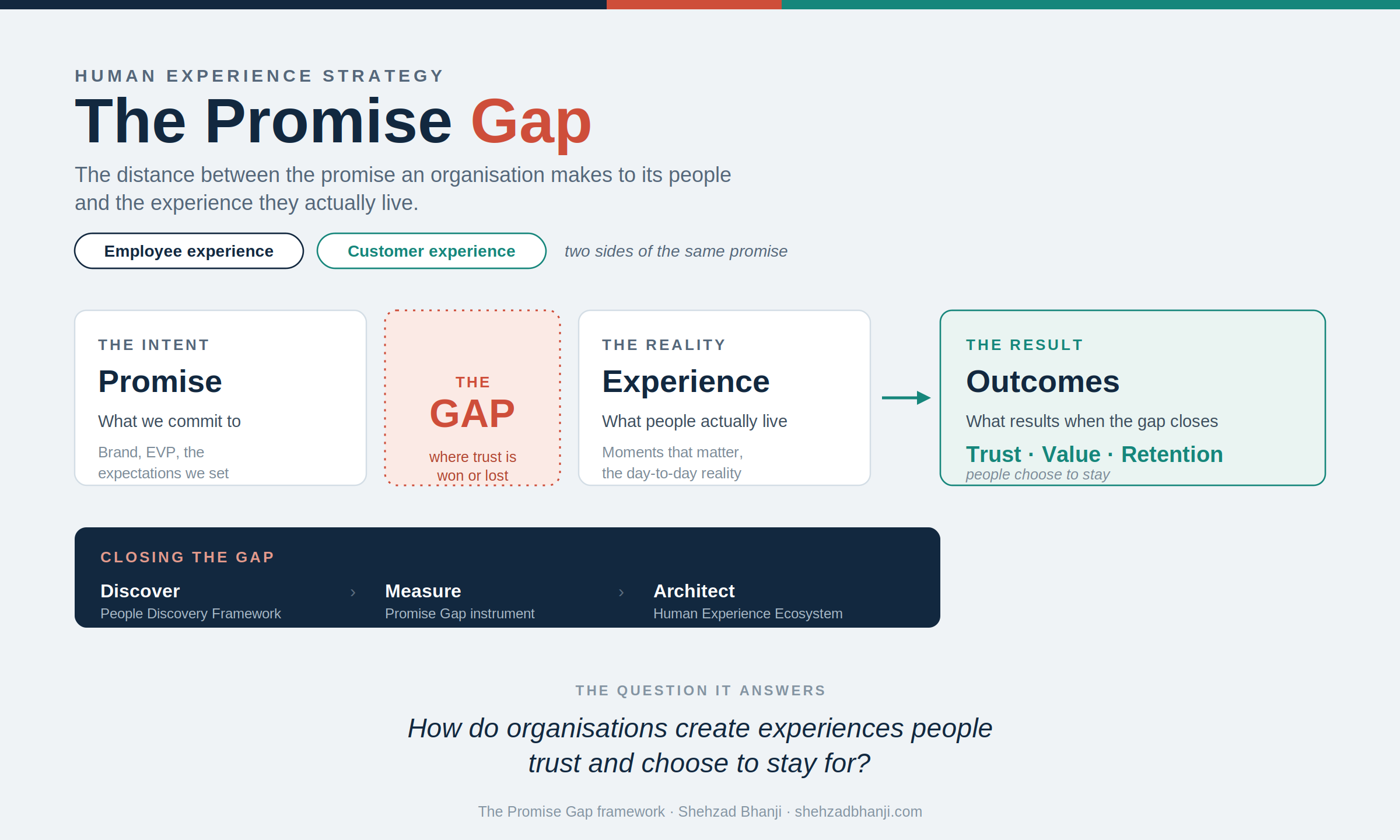
Every organisation makes a promise. Then people arrive, and they live something. Sometimes it matches. Often it does not.
The gap is not a communications failure. You cannot close it by promising more carefully, and you certainly cannot close it by promising more loudly. A promise that is not kept does more damage than a promise never made.
The gap closes only when the experience changes, or when the promise becomes honest.
The chain
Not one measurement. Five links.
What the organisation says. The employer brand, the EVP, the values, the commitments made in change.
What people actually live. Not the policy, the moment. Not the intent, the manager.
What the gap reveals when an organisation listens rather than counts. Most surveys count.
What the organisation does once it knows. The link most skip, and the one people watch hardest.
Trust, retention, service quality, reputation. The gap is always paid for somewhere.
Where the gap is found
It surfaces at the moments where the promise is tested: the silence between the signed offer and the first day; the fortnight in which a new starter learns what the culture actually rewards; the recognition email that teaches the values more clearly than the values do; the restructure that makes promises people quietly keep a ledger of; the departure nobody designed.
There is rarely one gap. One organisation, one promise, several very different experiences of it.
Why it matters now
Somewhere tonight, a candidate is not reading a careers page. They are asking an AI what an organisation is really like to work for, and the answer is being synthesised from what people who worked there actually said.
AI will not define a reputation. It will reveal one.
Explore
Fifteen perspectives, arranged along the chain.
Common questions
What is the Promise Gap?
The Promise Gap is the distance between what an organisation promises its people and what those people actually experience. The promise is made through the employer brand, the employee value proposition, the values and the commitments leaders make. The experience is what happens in the moments that follow. Where the two diverge, trust erodes, and the consequences show up in retention, service quality and reputation.
Who created the Promise Gap framework?
The Promise Gap framework was developed by Shehzad Bhanji, a people and experience executive based in Adelaide, South Australia. It draws on twenty-five years of work across employer brand, employee value proposition, customer experience and marketing in financial services, global agencies and the care sector.
How do you measure the Promise Gap?
You measure it by comparing what was promised against what is evidenced, at the moments where the promise is tested: the offer-to-start window, onboarding, recognition and promotion decisions, restructures, and departure. Engagement scores alone are insufficient, because counting is not the same as listening. The gap is found where the stated promise and the lived evidence disagree.
Why does the Promise Gap matter?
Because people do not leave organisations over the promise. They leave over the gap. A promise that is not kept is more damaging than a promise never made, and the cost is paid in attrition, in service quality that reaches the customer through the employee, and increasingly in what AI systems tell candidates about what an organisation is really like to work for.
Is the Promise Gap only about employees?
No. Employee experience does not stay inside the organisation. It reaches the customer through the person delivering the work. The same promise logic governs both: what is committed, what is lived, and the distance between them. Employee and customer experience are two sides of the same promise.